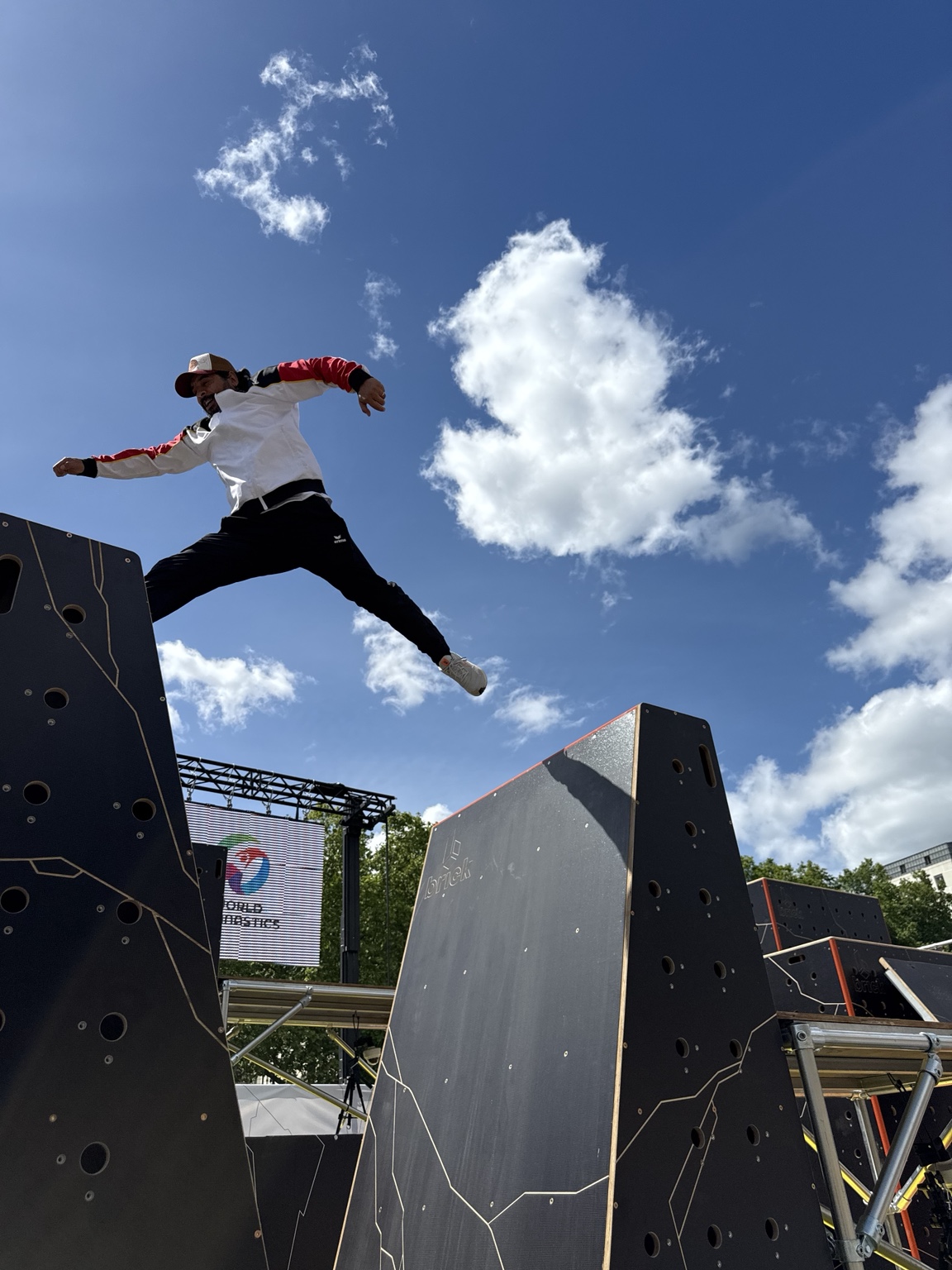
The starting point
What is Parkour?
Parkour is the art of moving from one point to another through efficient, fluid and controlled movement. Running, jumping, climbing, swinging, balancing and landing are used as an adaptive movement chain rather than as isolated skills.
Modern Parkour took shape in the 1990s in Lisses and Évry, south of Paris. David Belle combined the movement principles passed on by his father with training on stairs, walls and railings alongside his friends. Their group was called Yamakasi. Its influence reaches far beyond spectacular movement: community, discipline, courage and learning together remain central to Parkour culture.
Television, advertising and films such as Yamakasi and District 13 brought this movement culture to a global audience. A training method became an international sporting and cultural field.
A new phase
From sharing culture to official competition
The founding generation’s caution towards competition is an important part of Parkour history. The original focus was not defeating another person, but overcoming personal limits and sharing knowledge.
As Parkour grew worldwide, so did the need for shared safety standards and comparable formats. The Fédération Internationale de Gymnastique (FIG), now presented publicly as World Gymnastics, approved the development of Parkour in 2017; the first World Cup series followed in 2018.
Official international competition now has two main categories: Speed and Freestyle. Community and competition do not have to cancel one another out: knowledge is shared in training, while time, difficulty and execution are measured on the field of play.
01 · Speed
Speed Parkour
Speed, endurance, technique and strength — in one run.
From A to B
Speed is a timed run in which the athlete completes the course from start to finish as efficiently and quickly as possible. International races may use two parallel lanes. Some layouts include a turn, but the universal definition is movement “from A to B”; returning to the start is not mandatory.
Line choice, approach, take-off angle, ground-contact time, obstacle technique and momentum transfer must be managed together. The shortest-looking line is not necessarily the fastest if it costs control.
No room for carelessness at checkpoints
Every designated checkpoint must be passed correctly. An athlete who notices a missed checkpoint may return before crossing the finish line. Crossing the finish without completing all checkpoints correctly results in disqualification for that run.
Leaving the course boundary can likewise lead to a line violation and disqualification.
Qualification
The overall time ranking matters — not simply whether the athlete finishes ahead of the runner in the other lane.
Semi-final · KO
With 20 or more entrants, the top 16 advance; with 12–19, the top 10. Losing a duel removes the direct qualifying place, but the fastest losing times may still reach the final.
Final
Athletes again race in pairs, but under the current international rules the final ranking is based on time, not solely on winning the head-to-head race.
Speed 100 m World Record
World Gymnastics now maintains separate women’s and men’s world records on standardised 100-metre record courses. Any official scoring run at a record-eligible competition may establish a record. The first official marks were registered at the Montpellier World Cup in May 2026.
02 · Freestyle
Freestyle Parkour
Technique, tactics and choreography — all in one run.
Freestyle is a performance lasting between 20 and 45 seconds. Athletes choose their start, finish, obstacles and movement sequence. Freedom does not mean randomness: the strongest runs unite technical capacity, spatial analysis, energy management and safety.
Difficulty
The D panel assesses the base values in the 2026 Table of Tricks and how the skills are actually performed. The three highest successfully completed skills form the D score; no more than two may come from the same category.
Placement, form, entry and exit can scale the value upward. A Swing Double Gainer directly connected from a Giant Swing is harder than the same skill from support. A severely failed skill does not count for Difficulty, and repeated skills are not counted again.
Execution
The E score consists of Safety worth 9 points and Flow worth 6 points. Safety combines a 6-point deduction base with 3 points for Landing Quality; Flow combines a 5-point deduction base with 1 point for Flow Quality.
The panel therefore does more than deduct errors. Landing quality and the overall quality of the run are also rewarded.
Safety deductions
Slips, stumbles, hand or knee contact, falls and major collisions lead to deductions according to severity.
Landing Quality
Quiet, soft and aligned landings with controlled energy absorption receive the strongest evaluation.
Flow deductions
Stutter steps, unnecessary large steps, abrupt direction changes, extra swings, hesitation and stops interrupt flow.
Flow Quality
Rhythm, connections, use of direction and energy transformation are assessed across the whole run.
“Competition skills should be securely learned, consolidated and already tested within a complete performance.”
Judging structure
How many judges are required internationally?
One Start/Time judge, two Time judges and four Line judges. One of these judges also acts as the CJP, the Chair of the Judges’ Panel.
Three D judges, three E judges and two Line judges. Depending on the competition level, one panel member also acts as CJP.
Judges evaluate independently. Digital scoring and video systems support documentation, traceability and technical review. Good judging is not merely knowing the name of a skill; it is applying the same standard to every athlete, on every run and under pressure.
Final thought
Competition does not have to erase the spirit of Parkour.
When designed well, competition gives athletes a target, coaches measurable development criteria, organisers shared standards and spectators an understandable experience. The sharing culture remains alive: everyone shares the same space, risk and work.
In Speed to the final centimetre, and in Freestyle to the last skill, technical mastery and safety must remain together. Success in Parkour is not only about being fast or difficult — it is about acting with control, at the right moment and in a sustainable way.
Wishing everyone success.
Mustafa Karaca