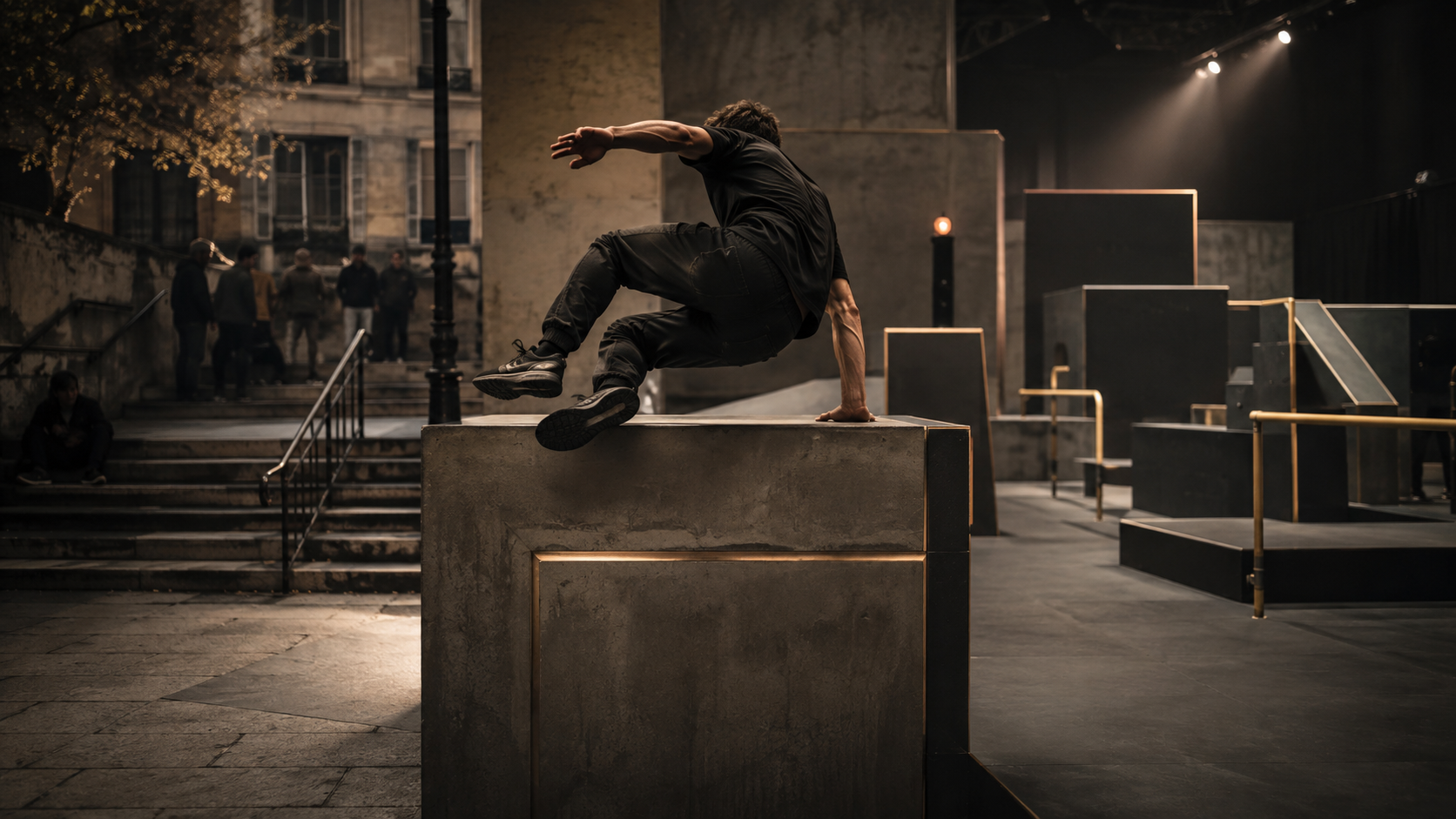
The starting point
Parkour was not born at a committee table.
Parkour took shape in the 1990s in Lisses and Évry near Paris. David Belle, Charles Perrière and the Yamakasi generation did not see walls, stairs and rails as boundaries, but as questions. Movement became a path to discipline, courage, mutual support and a new relationship with urban space.
Film, television and advertising carried that culture around the world. What began as collective training and personal challenge became both a global movement and, later, an international competition sport.
Parkour does not have two rival faces. It has two strengths that need one another.
Community culture
Creativity, self-organisation, peer learning, open jams and a new way of reading urban space.
Organised competition sport
Measurable progress, educated coaches, rules, safeguarding, sports science and long-term pathways.
Strength 01 · Community
The street is Parkour’s memory.
Creativity grows where every line has not already been prescribed.
Jams, challenges, self-organised meetings and peer learning produced many of the techniques, training ideas and values that now feed competition. Entry is accessible, motivation grows through the group, and progress can matter without a ranking deciding its worth.
This culture is not automatically chaotic or irresponsible. Many independent organisations have sophisticated educational, ethical and safety models. Parkour.org has developed club structures and coach education for more than 15 years. ParkourONE treats Parkour as a holistic educational tool. In Ulm, STREETS e.V. connects coached sessions, self-organised outdoor practice and the annual Parkour Ulm Jam.
The strength of the scene is its closeness to people. Its possible weakness arises where safe progression, age-sensitive pedagogy, insurance, emergency planning or qualified guidance are missing – not from the street itself.
Strength 02 · Sports system
Structure can make development visible and sustainable.
World Gymnastics organises Parkour through Speed and Freestyle. Rules, judges, rankings and international events make performances comparable. When implemented well, this structure can support long-term planning, medical care, anti-doping, safeguarding, coach education, insurance, public funding and professional pathways.
Federation status is not an automatic certificate of safety. Early specialisation, result pressure, poor load management and insufficient education can also occur in organised sport. An institution is therefore not a guarantee; it is an opportunity to make responsibility binding.
People as bridges
Origin and institution are already connected.
Charles Perrière
A member of Yamakasi and, since 2019, President of the World Gymnastics Parkour Technical Committee: a direct bridge between the founding culture and international rules.
Aimene Boustila
An international judge and technical delegate; a member of the Parkour Technical Committee since 2025 and active in the practical development of international competition.
Nicolas Fischer
A Swiss movement scientist, athlete and coach who has contributed to international Parkour academies, coach education and judging development.
These examples show that an institutional model need not stand outside Parkour culture. When athletes, coaches, scientists and long-serving community members genuinely share decisions, historical experience and professional structures can grow together.
Similar bridges are emerging within national federations. Lukas Steiner, an Austrian Parkour and freerunning pioneer, former Art of Motion athlete, academy founder and coach, now contributes to the European Gymnastics Parkour working group developing the 2027–2029 plan. In Türkiye, Can Doğukan Bul brought his street Parkour and coaching experience into the Türkiye Cimnastik Federasyonu. His national-team experience followed from this integration into the federation structure. Both show how people can carry their roots in practice into institutional responsibility.
The uncomfortable question
Is street Parkour more dangerous?
The evidence does not currently support a serious blanket answer. A Madrid study involving 161 practitioners reported a high prevalence of injury but did not directly compare street and competition Parkour. A 2025 scoping review found very little robust evidence on adverse experiences and injuries among children and adolescents.
Individual accidents should not be used as proof against an entire culture. Yet risks should not be romanticised. Unsafe spaces, social-media pressure, untested heights, missing progressions and a lack of guidance can have severe consequences. The right conclusion is not to prohibit the street, but to improve research, teach risk competence and create safe learning pathways.
Shared responsibility
Federations must listen – communities must participate.
Parts of the Parkour community strongly criticised FIG’s move into the discipline in 2017. Identity, autonomy and legitimate representation were central concerns. Those objections should not be edited out of history; they belong at the table.
A sustainable future is not created when an institution takes possession of a culture. It is created when the culture helps shape the institution.
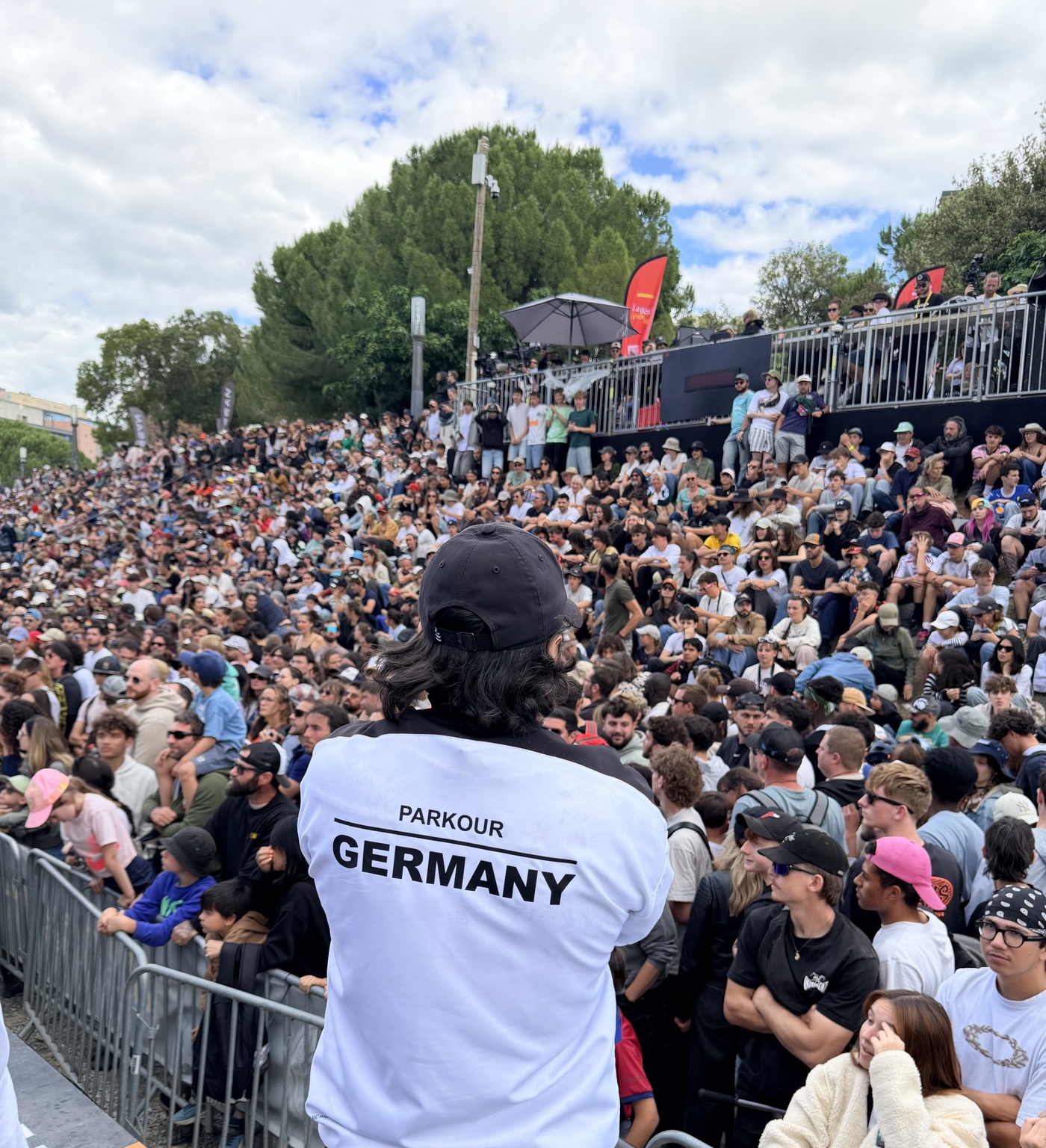
Six recommendations
What national federations should do next.
Create more opportunities
Local, regional and national events should form a visible development pathway.
Include experience
Long-serving street and competition athletes belong in commissions, education teams and decision-making.
Strengthen education
Coach education, safeguarding, first aid, load management and pedagogy must be developed together.
Work with cities
Parkour should be explained clearly to municipalities and translated into safe movement spaces.
Fund athletes
Travel, training, health and competition costs cannot remain solely the athlete’s private responsibility.
Build bridge formats
Jams, workshops and competitions can learn from one another within the same event.
To the IOC
From the Paris suburbs to the Olympic flame.
Why is a sport this clear, dynamic and organically grown still not Olympic?
Speed is immediately understandable. Freestyle combines difficulty, execution, creativity, flow and courage. Compact venues, powerful images and a young global audience make Parkour particularly suitable for arenas, broadcasting and digital media.
Five additional sports were selected for LA28, and Parkour is not among them. The Olympic path naturally requires more than excitement: global depth, transparent qualification, stable competition, athlete protection, credible governance and sustainable cost. That is precisely why communities and federations should build these conditions together.
From the Paris suburbs to the Olympic flame would be more than a powerful image. It would be a great story of sport.
Conclusion
We do not have to choose a side.
Without the street, competition Parkour loses its memory, creativity and community. Without education, science and binding responsibility, free practice cannot offer the same sustainable pathway everywhere.
The real question is therefore not “street or competition?” It is: how can we protect Parkour’s freedom while building a safe, fair and lasting future for its athletes?
Two strengths. One shared future.
Mustafa Karaca