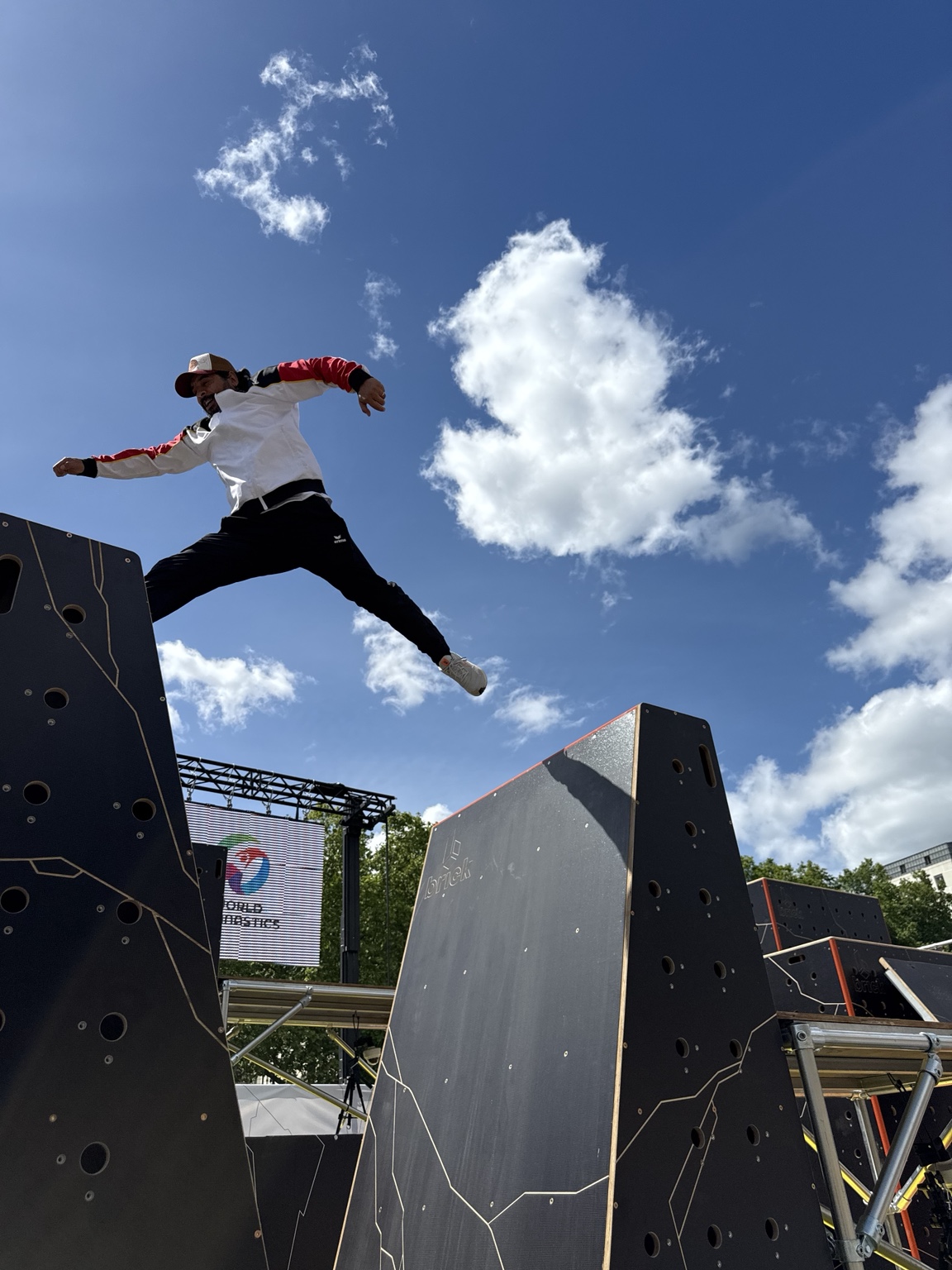
Understand the whole game
Difficulty alone does not win competitions.
You compete at elite level, trust your technical ability and can build a strong D-score. But if the E-score still causes problems, you are not yet playing the whole game. The best player is not only highly skilled; they understand the rules.
In Freestyle, three E judges and three D judges evaluate the run. The E-score is worth up to 15 points and considers Safety, Landing Quality, Flow and Flow Quality. Judges are not your opponents. They assess every performance independently and by the same standard, often seeing details that spectators – and sometimes coaches – cannot.
A random run may collect applause. A planned run collects points – and protects them.
The rule is not “stop putting on a show”. It is: never create a show moment without a plan. Every step, glance, breath and the timing of your finish should serve a deliberate decision.
Five golden rules
01 · Learn the panel.
If you know what is evaluated, you can train for it.
Safety
Are you still in command when something changes?
Landing Quality
Are your landings quiet, controlled and ready to connect?
Flow
Do you avoid stops, stutter-steps and hesitation?
Flow Quality
Does the whole run have rhythm, direction and purpose?
These are not merely terms for the judges’ table. They should guide your training plan, video analysis and choreography.
Golden rule 02
Prepare variations – not only individual tricks.
You may see the course only a few hours before your start. That does not mean your choreography should begin there. Build movement and connection patterns that adapt to different obstacles.
Do not train only the D skill. Train the route into it and out. Surround scoring skills with basic Parkour connections and work in blocks of at least 60 seconds, after the main load when fatigue appears. Your competition run lasts no more than 45 seconds, but your decision-making must last longer.
Golden rule 03
Safe-ty.
The skill is not only in flying. The skill is in landing.
Much of a run takes place in the air, with rotations, changes of direction and different body positions. Every flight ends with ground contact. That moment reveals whether you controlled the movement or simply arrived because gravity required it.
A good landing is learned, repeated and tested in combinations. It also contains a plan for the fraction of a second when reality differs from expectation. What happens after contact? Are you rescuing yourself, or does the first step lead steadily into the next action? That is the difference between visible control and risk.
Compete with movements you control not only in isolation, but under fatigue, pressure and in combination.
Golden rule 04
Be fluid – and intelligent.
Your steps should be deliberate, compact and purposeful: no unnecessary adjustment, searching glance or stop. Do not spend all your attention on one high-value skill. Build the route towards it.
A spectacular skill may bring a high D value. If you brake before it, search for direction afterwards or lose the plan on landing, you pay in E-score. Real dominance is not only the hardest trick; it is control across the whole run.
Golden rule 05
Keep the run alive.
Continuity creates Flow Quality.
Whatever happens, do not surrender your rhythm. If a connection fails, move to your prepared alternative without visible hesitation. One error need not dismantle the run. Backup training determines whether a problem becomes a short adjustment or a long interruption.
Flow Quality considers the entire run. Choreography should feel like one movement with a beginning, development and deliberate finish – not a collection of separate tricks.
Bonus · Re-do
A second chance is not a safety net.
In qualification, you may request a second run. Signal by raising your hand immediately after run one ends and before the score is displayed. The decisive detail: only the second run counts. The first result is not retained as insurance.
If run one does not represent your performance and you are physically and mentally ready, a re-do can be useful. But a run costs energy, and your opponents have seen your lines. “Maybe the judges missed it” is not a strategy. Understand the consequence, decide immediately and commit to run two.
Final thought
The E-score is not a nightmare. It is feedback.
It shows whether difficulty, control and choreography truly work together. Plan your lines, train connections under load, prepare alternatives and treat every landing as part of the next movement.
Then you are no longer trying to escape the judges. You give them a run whose quality cannot be missed.
Wishing you success.
Mustafa Karaca